Where can terrazzo be used, and how heavy is it?
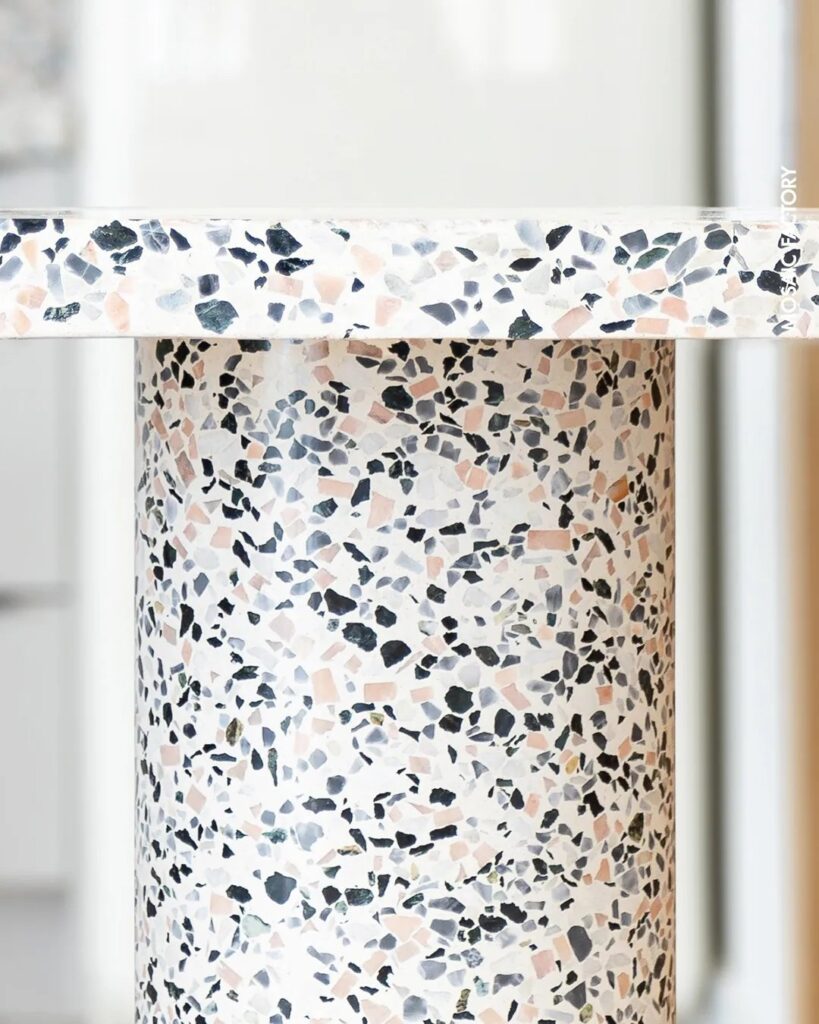
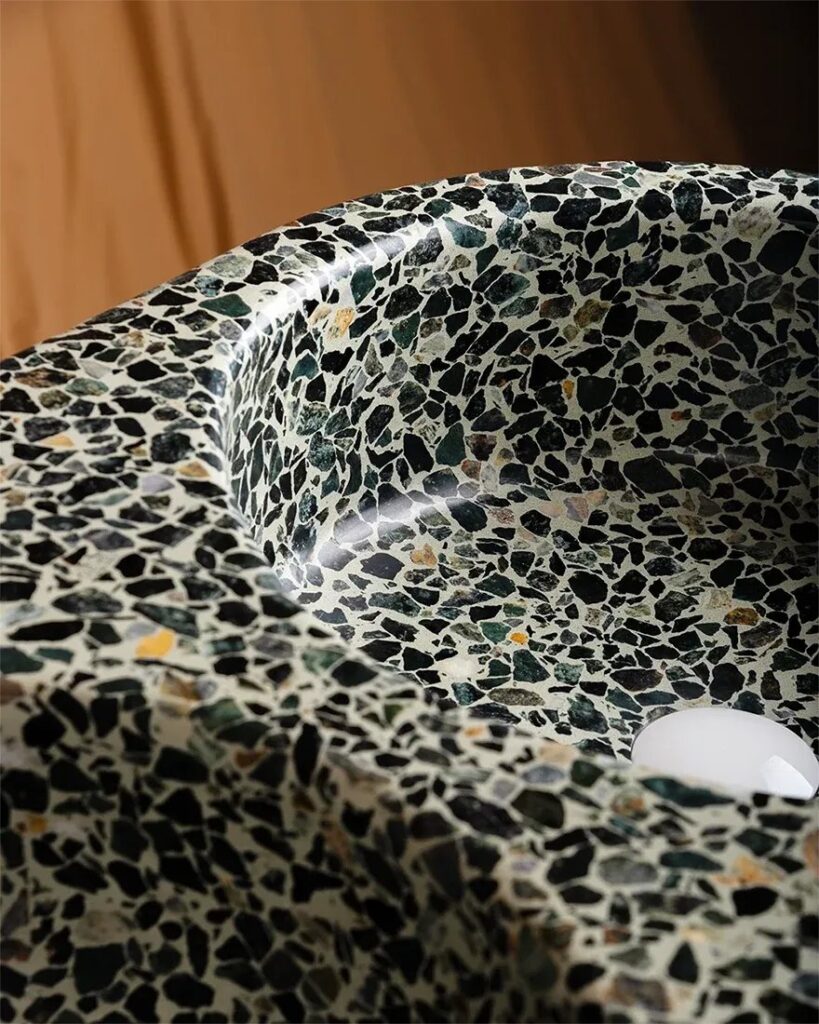

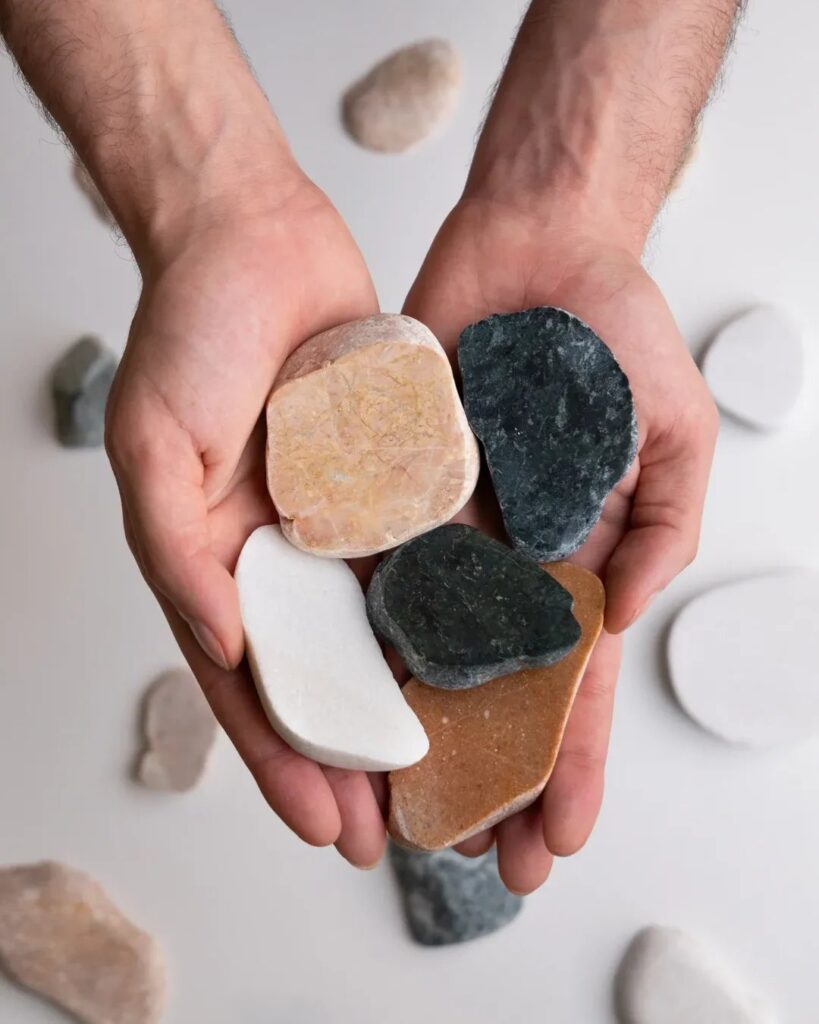
Reference photographs. They show the material and the finish; they are not photographs of goods we made, and the colour on screen is not a colour-match.
The figures, and where each one comes from
| Item | What is published | Source |
|---|---|---|
| Resin thin-set terrazzo | nominal 1/4" or 3/8" (6.4 to 9.5 mm); 3 to 4 lbs per sq ft | NTMA system list, via Terrazzo Specialist |
| Polyacrylate terrazzo | nominal 3/8" (9.5 mm); 4.5 lbs per sq ft | NTMA system list, via Terrazzo Specialist |
| Monolithic terrazzo | 1/2" (12.7 mm); 5 to 7 lbs per sq ft; on grade or below grade only | NTMA system list, via Terrazzo Specialist |
| Bonded terrazzo | 1.75" to 2.25" including the topping; 18 to 22 lbs per sq ft; needs 1.25" to 1.75" of recess | NTMA system list, via Terrazzo Specialist |
| Rustic terrazzo | non-ground textured surface for exterior use; weight follows the system chosen | NTMA system list, via Terrazzo Specialist |
| Sand cushion terrazzo | 2.5" to 3" including the topping; 25 to 30 lbs per sq ft; called the best cement system | NTMA system list, via Terrazzo Specialist |
| Dead load, converted | 3 to 4 lbs/sq ft is 14.6 to 19.5 kg/m2; 25 to 30 lbs/sq ft is 122 to 146 kg/m2 | conversion of the above at 4.882 kg/m2 per lb/sq ft |
| Federal specification | the 2024 GSA P100 durability table lists cementitious polyacrylate terrazzo at a 3/8" baseline and epoxy terrazzo at 1/4" or 3/8", Tier 3 | Craftsman Concrete Floors, citing GSA P100 |
| Shower floor finish | honed or lightly abrasive is mandatory; a polished floor can be extremely slippery when wet | ABD Stone |
| Shower pan fall | a minimum of 1/4 inch per foot | ABD Stone |
| Tanking under showers | sloped mortar beds under shower tiles; modern membranes alone cannot replace the fall | Coloria Group |
| Walk-in shower sealing | high-coverage sealing, about 97% with penetrating sealers, re-applied yearly | Coloria Group |
| Wet-room sealer interval | penetrating sealers in wet rooms need reapplication every 1 to 2 years | Coloria Group |
| Seamless pour in a shower | a poured pan, walls and bench can be made with no grout line at all | ABD Stone |
| Steam cleaning | pushes moisture deep into the seams unless the grout carries silica-enriched hydrophobic additives | Coloria Group |
| Commercial pools | epoxy withstands decades when paired with drainage cells below the tiles; cement variants erode quickly near salt water | Coloria Group |
| A real failure, quoted as one | a Miami beachside cafe ran cement terrazzo indoors and extended it to the patio against recommendation; after two tropical storm seasons salt water penetrated the seams and dissolved the mineral binder internally, and repairs cost 300% more than proper exterior pavers would have | Coloria Group |
| Freeze-thaw, outdoors | specify resin with glass or porcelanite aggregate only | Coloria Group |
| UV, outdoors | epoxy terrazzo does not fare well in exterior applications because of UV exposure; rustic cement is recommended | TERRAZZCO, a manufacturer comparison |
| Breathability, outdoors | outdoor environments require breathable cementitious matrices to prevent moisture entrapment; polyacrylate is identified as the freeze-thaw and UV system | Guiyi Net selection guide |
| Slab deflection, thin-set epoxy | L/360 maximum | Guiyi Net selection guide |
| Slab flatness | 1/8 inch in 10 feet, FL 50; a cement system can reach FL 50 on its own underbed | AK Level and Polish; TERRAZZCO |
| Slab moisture | in-situ relative humidity above 80% requires a 100% solids moisture vapour barrier to ASTM F3010 | AK Level and Polish |
| Mechanical key | shot-blast the slab to ICRI CSP 3 to CSP 4 | AK Level and Polish |
| Stress isolation | a full-coverage elastomeric membrane, 40 mils wet film, reinforced over dynamic joints | AK Level and Polish |
| Aggregate ratio, epoxy | 1:4 to 1:5 resin to aggregate by weight, trowelled to 3/8", rolled to 80%+ visible aggregate | AK Level and Polish; CSI 09 66 23 |
| Cure before grinding | epoxy 12 to 24 hours; cementitious systems require 28 days of wet curing | AK Level and Polish; Guiyi Net |
| Setting material for resin tile | a resin-bound tile back does not bond reliably to cement thin-set; epoxy-based adhesive is required, and the wrong one is a common cause of later failure | Marble Systems Nougat installation guide |
| Seal before grouting | cement-based tile is sealed on the face before grouting, as grout release, the way marble is | Marble Systems Nougat installation guide |
| Perimeter joint | about 1/4 inch between the tile field and adjoining fixed surfaces, plus movement joints across larger fields | Marble Systems Nougat installation guide |
| Waste allowance | order 10 to 15% extra for cuts, waste and future repairs | Marble Systems Nougat installation guide |
| Batch | terrazzo varies more between batches than a solid-colour tile; confirm one batch for the project and dry-lay to blend | Marble Systems Nougat installation guide |
| Divider spacing, epoxy | 15 to 20 feet, and any shape is permitted | TERRAZZCO, a manufacturer comparison |
| Divider spacing, cement | limited to squares and rectangles, about 4 feet | TERRAZZCO, a manufacturer comparison |
| Poured has no joints | a monolithic pour has no grout line; a tile field has one every 4 feet in cement, every 15 to 20 feet in epoxy | derived from the two rows above |
| Volume change | epoxy is 100% solids with no volume change; cement is water-hydrated and shrinks as water evaporates, which is why cement needs dividers at 4 feet | TERRAZZCO, a manufacturer comparison |
| Service life, resin and cement | both systems are published at 40+ years, and with proper care terrazzo can last the life of the building | TERRAZZCO, a manufacturer comparison |
| Service life, historic | properly maintained terrazzo floors routinely remain serviceable for a century or more | Terrazzo Specialist restoration guide |
| Life-cycle value | 40-year life-cycle value compared against vinyl tile | Guiyi Net selection guide |
| Where an institution mandates it | the 2021 US Courts Design Guide directs certain public-circulation courtroom areas to terrazzo or stone and rejects polished concrete there; FGI application guidance calls for seamless flooring with an integral 6-inch cove in identified critical clinical environments | Craftsman Concrete Floors, citing US Courts and FGI |
| Preservation standard | historic materials are to be retained and repaired where feasible, and new work should match the historic material in design, colour, texture and composition | US Secretary of the Interior's Standards |
| What wears first | wear is decided by the binder and the finish, not by the aggregate: a pale floor shows scratching, a dark floor shows loss of gloss | derived from the polishing and sealing pages on this site |
Why the processes are not interchangeable
A terrazzo floor is not a finish, it is a build-up: a binder, a thickness, and sometimes a sand cushion under it. The thickness decides the dead load, the dead load decides what the structure can be, and where water comes from decides which binder is legal. Fix the system first and the colour is a free choice; fix the colour first and you are choosing between a floor that goes on the slab and a floor that needs the slab cut away.
What these figures are, and what they are not
Every figure below is published by somebody else: the NTMA system list, a federal specification, a preservation standard, or a trade contractor who was on a job. We hold no structural calculation and no test report. What we do is tell you which system we form, what it weighs, and what it needs underneath — and then quote against a real batch.
If you are specifying this
We have not published products against this question yet. Send us the process, thickness and quantity and we will quote it against what we can actually form, rather than against a catalogue.