The workshop behind the quote
Two floors with the same surface can differ by more than half. The difference is what happened before the first chip was ground flat, and it is not visible in a sample.
Where the floor is actually made
Terrazzo is processed in Shuitou in Fujian and Yunfu in Guangdong. Both are stone clusters with cutting, calibrating and polishing capacity within driving distance of each other, which matters because the binder is the clock: cement-bound material gains strength over weeks and a resin sets in hours, and both need to be ground before either is ready.
The batches are cut against a photograph of the batch, not against a photograph taken last year. That is why a second order is never automatically the first order again, and why the answer page on batch matching is unusually blunt about it.
- Block sawing, calibrating and resin application in the cluster
- Casting and pressing for the precast panel line
- Grinding and polishing to a stated finish level
- Cut-to-size, mitres, cut-outs and a final piece check before packing
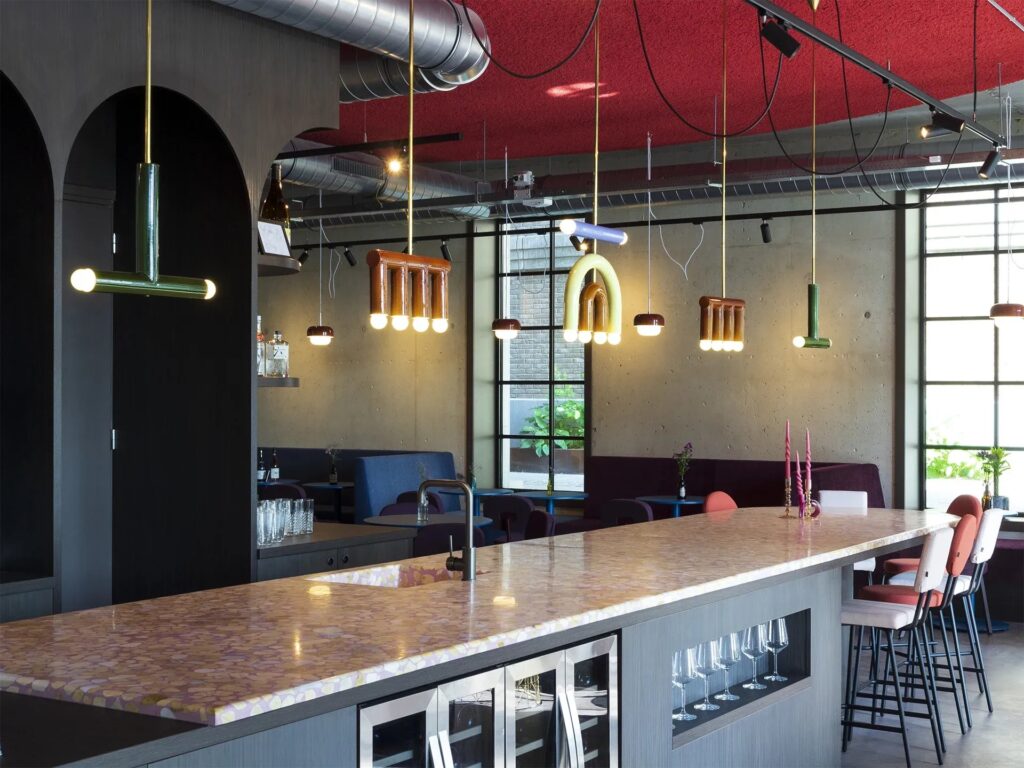 Reference photograph. The picture on this page shows a workshop of this kind, not a machine specification.
What the machines are for
Each step below exists because the next one cannot be done without it. A floor is made by grinding, not by pouring.
Block sawing
Opens the block into slabs at a thickness the gang saw can hold flat, before any surface decision is made.
Calibration
Grinds the back of the slab to a constant thickness so the face can be ground to a constant thickness too.
Casting and pressing
For the precast line: aggregate and binder under pressure, then cured before any finishing.
Grinding
The step that makes the floor. A cement-bound topping does not exist until a grinder has cut through the matrix to the stone.
Polishing
Progressive grit to a stated level. The level is a specification, not a preference, because a high polish and a wet floor do not sit together.
The finishes, and which one to ask for
Finish is a specification with consequences, and the consequence is decided before the floor is laid.
Polished
Full gloss. Reads as the most finished surface and is the least forgiving underfoot when wet.
Honed
Matte. The finish most wet rooms and stair treads are given, because it does not become a mirror when it is wet.
Ground
Satin, with the aggregate texture still legible. Between honed and polished.
Brushed or leathered
A texture that hides a mark. Asked for where the floor takes traffic rather than display.
What we can state, and what we cannot
The second column is the important one. It is where a supplier stops answering and starts estimating.
A figure with no clause behind it is not useful to somebody specifying a floor, and it is the easiest thing in this trade to invent. Where we do not hold a figure, this site prints <em>not tested</em> and leaves the cell empty.
How a floor moves from block to specification
The order of these steps decides what a claim on delivery can honestly mean.
Block selection
Origin and grade recorded at the mine, before anything is cut.
Sawing
The block is opened and calibrated. Thickness is settled here, not later.
Matching the request
Slabs are set aside as a batch, so one floor comes from one lot rather than from four.
Finishing to a level
Ground to the stated finish. The level is agreed in writing before the work starts.
Cut to size
Templates, mitres and cut-outs. A piece that does not fit is made again rather than shipped and argued about.
Packing and loading
Recorded against the batch, with the photographs that describe it.
Three things we will not tell you
Not because they are unfavourable, but because they are not ours to claim.
A test result we do not have
No laboratory report for our own material is published on this site. Where a figure is quoted it comes from a standard and the clause is named.
A lead time in weeks
It depends on the batch, the finish and the port. A number here would be a guess wearing a calendar.
A price per square metre
It moves with aggregate, freight and the size of the job. Ask for a quotation against your own specification.
Tell us what the floor has to do
The room, the substrate and the finish decide which process is even possible. Send those three and the answer is usually one paragraph.