What are the six types of terrazzo?

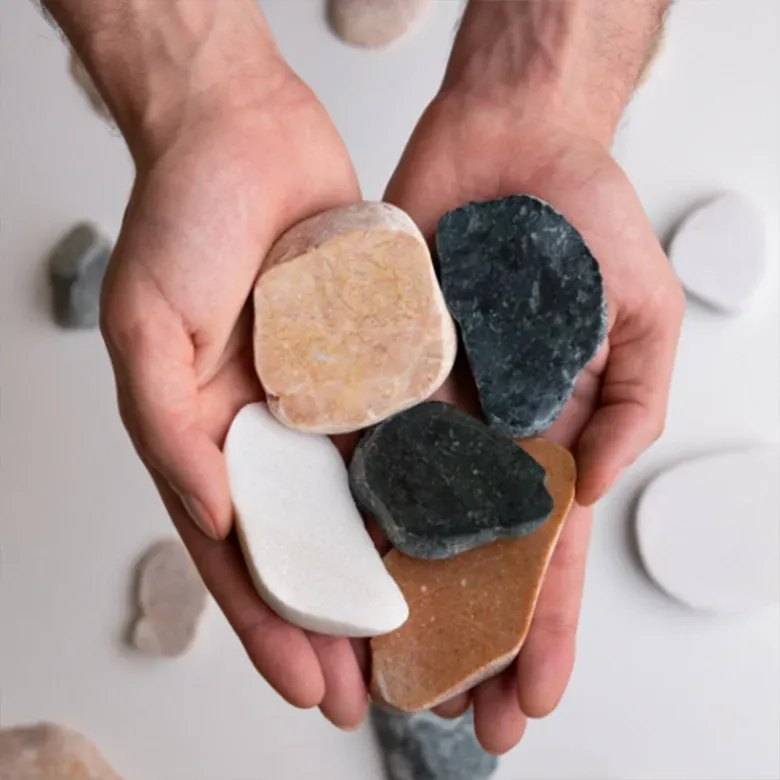

Reference photographs. They show the material and the finish; they are not photographs of goods we made, and the colour on screen is not a colour-match.
The figures, and where each one comes from
| Process | What binds it | Typical thickness | Repaired in place? |
|---|---|---|---|
| Precast | Cement or resin pressed in a factory | 20-30 mm body | tile by tile |
| Cement-bound | Portland cement laid on site | 10-15 mm over substrate | yes |
| Epoxy | Resin, laid thin | 3-6 mm | no, not the way cement is |
| Poured | Cement placed wet over the substrate | 8-12 mm | yes |
| Liquid | Water-based resin coating | 1-3 mm | no, it is a coating |
| Porcelain | Fired clay body, printed surface | 8-10 mm | no, it is a tile |
Why the processes are not interchangeable
The five real processes differ in what happens when the floor fails. Cement-bound and poured are ground together with the slab, so a damaged area can be patched and re-ground in place. Resin-bound is thin and chemically hard but it is a coating, so lifting it takes the substrate with it. Porcelain is not terrazzo at all — it is a tile that prints the look of terrazzo, and calling it terrazzo is how a specification acquires a figure it cannot support.
What these figures are, and what they are not
The thickness figures on this page are published ranges, drawn from how the processes are described in the technical literature. They are not measurements of anything we have made. Every figure we have measured ourselves is published on /download/ and labelled as ours; we hold none yet.
If you are specifying this
We have not published products against this question yet. Send us the process, thickness and quantity and we will quote it against what we can actually form, rather than against a catalogue.