How wide should the joints between terrazzo tiles be?
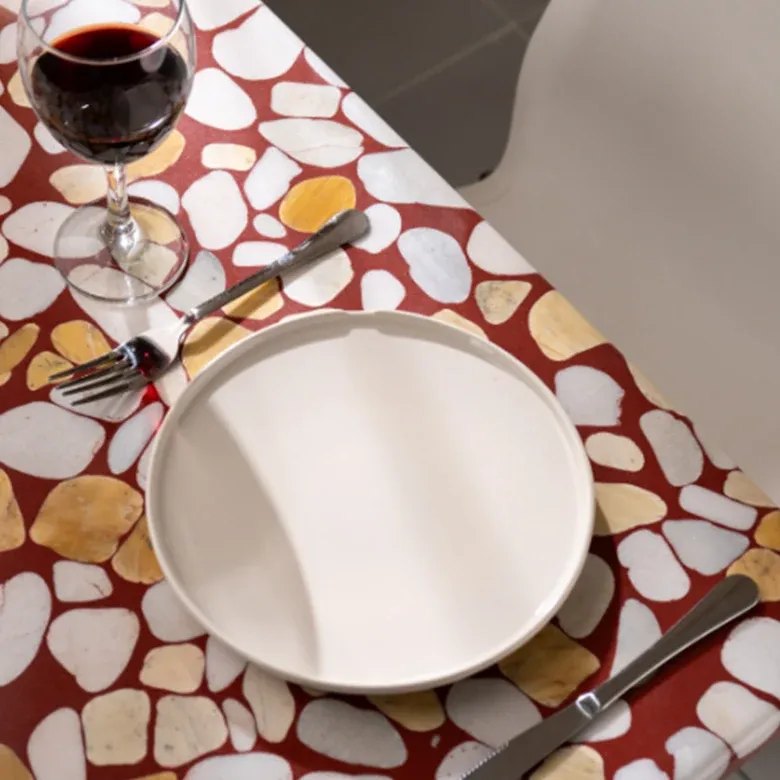
Reference photographs. They show the material and the finish; they are not photographs of goods we made, and the colour on screen is not a colour-match.
The figures, and where each one comes from
| Joint | What it does to the look |
|---|---|
| 1/16 in | almost invisible, needs precision |
| 1/8 in | the stated standard, a shadow line |
| 1/4 in | visible, reads as tile rather than as terrazzo |
| 18 to 24 gauge | the same widths expressed as strip gauge, per NTMA |
Why the processes are not interchangeable
A terrazzo tile gets its character from the aggregate running edge to edge, and a joint wider than about an eighth of an inch interrupts that at every edge of the room. This is also why grout colour is chosen against the matrix rather than against the chips: the grout is a line in the pattern, and if it is lighter than the matrix it becomes a grid that draws attention away from the floor. NTMA treats the divider strip as both a technical and a design element for the same reason, and notes that where major movement is expected the answer is an inset expansion plate rather than a wider joint.
What these figures are, and what they are not
The one-eighth and one-sixteenth inch widths, and the 18-to-24-gauge strip range, are from the NTMA Terrazzo Systems Reference Guide. ⛔ GB 50209-2010 sets no figure for divider strip spacing or width, so ⛔ there is no Chinese equivalent quoted here and none should be inferred from the absence.
If you are specifying this
These are the forms we actually supply for this question, with production photographs where we have them: