Is terrazzo a good kitchen floor?
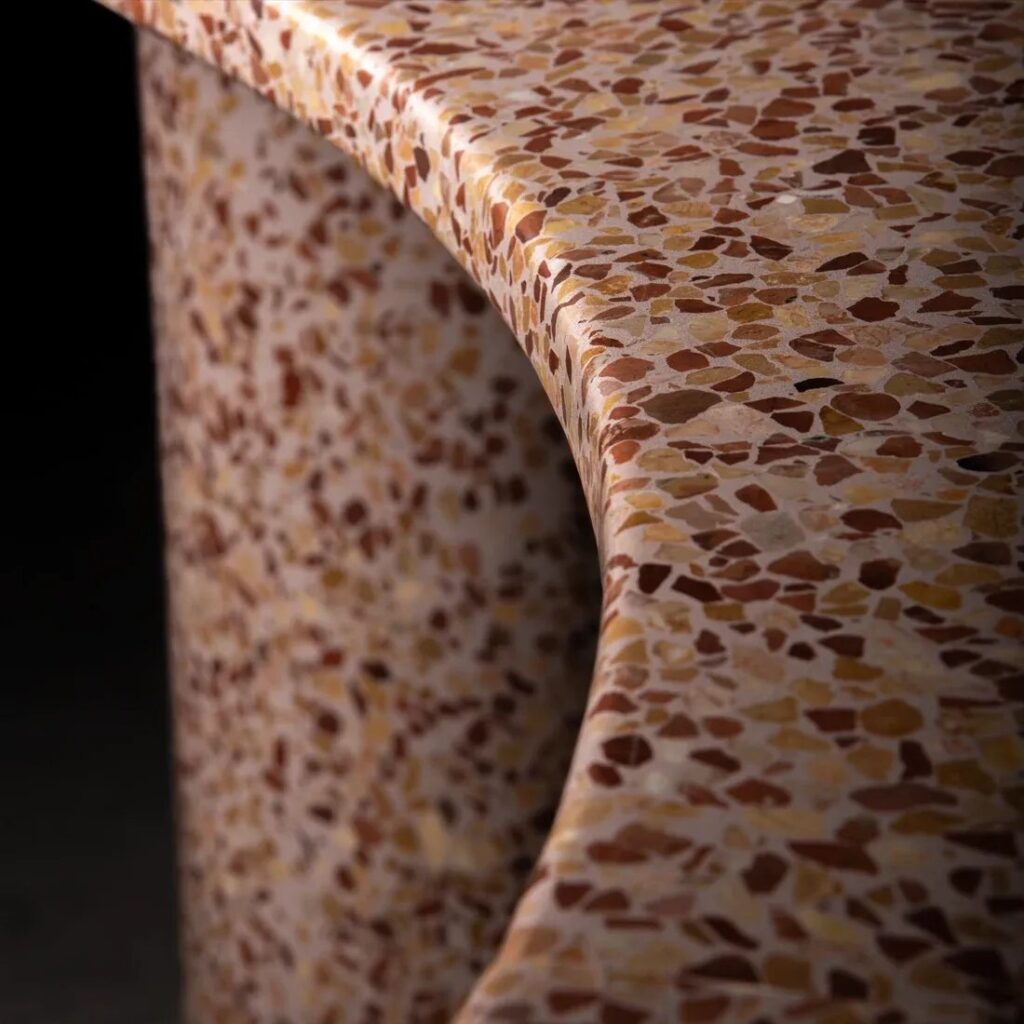
Reference photographs. They show the material and the finish; they are not photographs of goods we made, and the colour on screen is not a colour-match.
The figures, and where each one comes from
| In a kitchen | What to specify |
|---|---|
| Under a sink and a hob | fine marble or quartz aggregate, not large glass |
| Spills and oils | sealed, and the sealer kept up to date |
| Dropped objects | fine aggregate disperses; large glass chips micro-fracture |
| Cleaning | neutral pH only; acid dulls the matrix and etches the marble chip |
Why the processes are not interchangeable
The impact behaviour is the interesting part, and it is the one place where chip size is a performance decision rather than an appearance decision. Terrazzo is a composite: a dropped load is carried by the whole matrix rather than by one point, which is why a cast-iron pot leaves no dent where it would mark timber. But the matrix only spreads the load if the aggregate in it is not the brittle component. Large glass chips are the exception, and they are chosen for how they look in the light. In a kitchen where things get dropped, they are the wrong trade.
What these figures are, and what they are not
The advice on aggregate choice is general: ⛔ no test report supports a number on this page and none is offered. The cleaning boundary — no acid — applies to a cement matrix because acid attacks it and dulls a resin one; it is a material behaviour, not a measurement. ⛔ We have not tested a floor we supplied.
If you are specifying this
These are the forms we actually supply for this question, with production photographs where we have them: