How is terrazzo tested for wear?
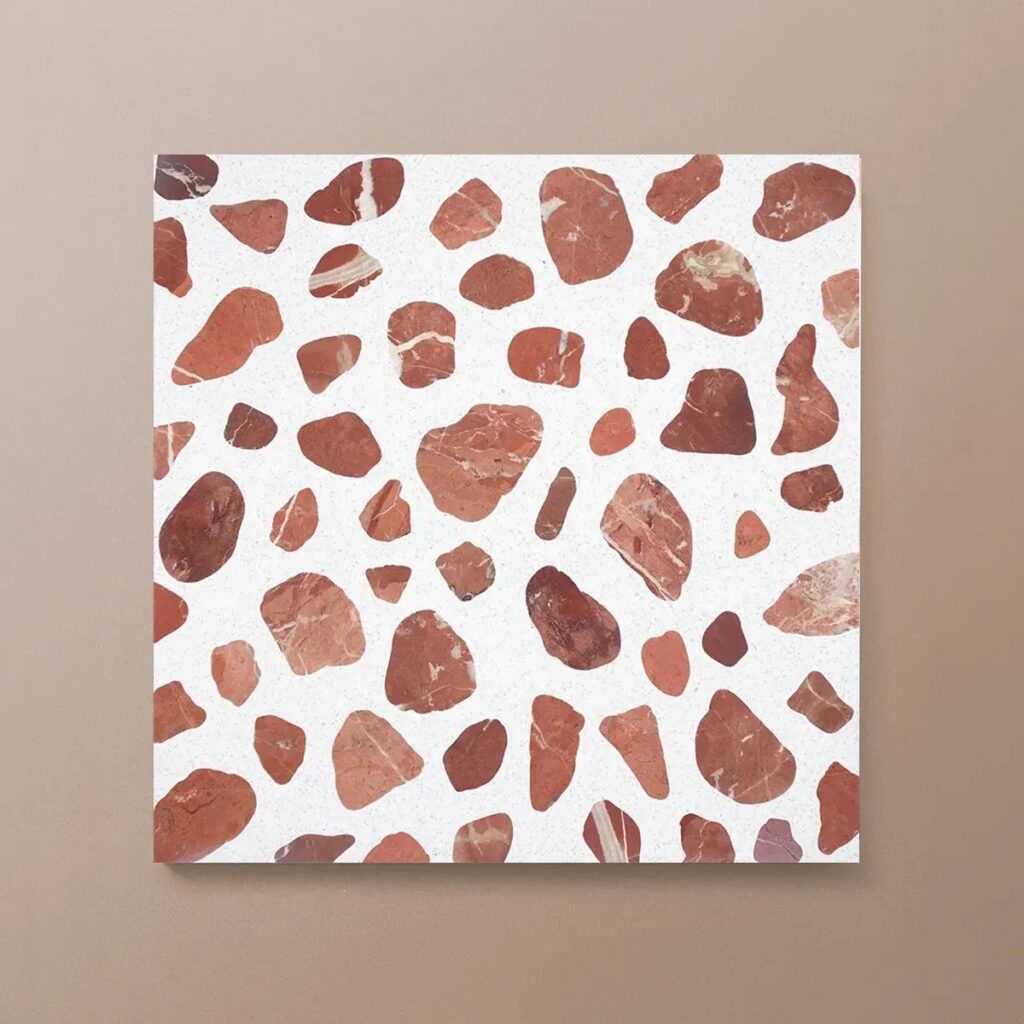
Reference photographs. They show the material and the finish; they are not photographs of goods we made, and the colour on screen is not a colour-match.
The figures, and where each one comes from
| Requirement | Value | Source |
|---|---|---|
| Wear index on a floor product | not less than 1.5 | JC/T 507-2022 cl.6.5.1 |
| Method | rotating ball bearing, fixed load | GB/T 16925 |
| Formula | index = square root of revolutions, divided by groove depth | GB/T 16925 cl.6.1 |
| Reported value | the mean of the middle three, extremes discarded | GB/T 16925 cl.6.2 |
Why the processes are not interchangeable
The formula is the useful part. Index equals the square root of the number of revolutions of the head, divided by the depth of the groove it cut. Higher is better because more revolutions for the same loss of material means slower wear. The reporting rule matters too: GB/T 16925 discards the highest and lowest results in each group of five and averages the middle three, so one outlier specimen does not move the number. Note that this is an index and not a linear scale, which is why two products at 1.5 and 3.0 are not twice as good as each other.
What these figures are, and what they are not
The 1.5 requirement is JC/T 507-2022 clause 6.5.1. The formula and the reporting rule are GB/T 16925 clauses 6.1 and 6.2, a standard approved in 1997 and still referenced by JC/T 507-2022 clause 7.6.1. ⛔ Be aware the method is dated, and expect to be asked about that. We have not tested a panel we supplied and hold no wear report.
If you are specifying this
These are the forms we actually supply for this question, with production photographs where we have them: